Choosing the right outdoor lighting
Short answer: Start with the spot. Pick the weather rating for how exposed it is (IP44 under a porch, IP65 or higher on an open wall or at ground level), then the brightness for the job and a warm white light. Point it down, and have an electrician fit anything that's wired in.
Updated
The right outdoor light guides visitors to your front door, lights the path after dark and lets you use the garden long after sunset. Which light suits depends on where it goes, so this guide starts there, then covers power, weather ratings, brightness and colour.
Start with where the light goes
| Spot | What to choose | Where to look |
|---|---|---|
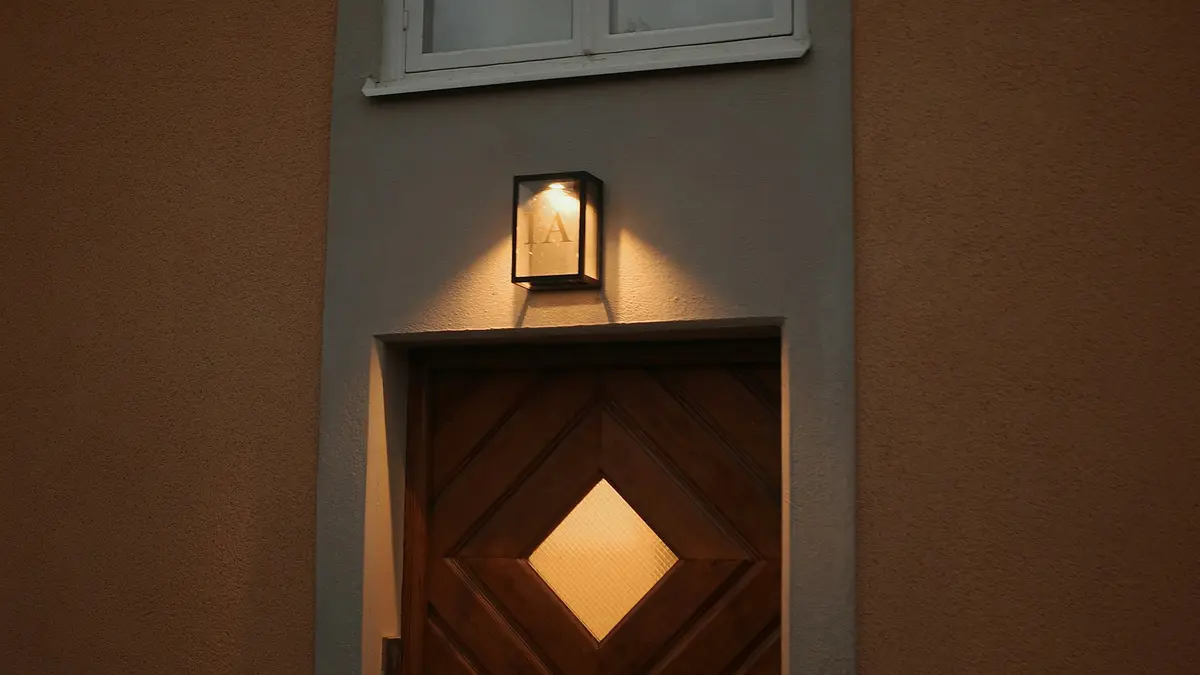
| Front door and porch | A wall light or lantern either side of the door. An up and down light washes the wall in both directions instead of glaring out at head height. | Wall lights, Lanterns, Up and down lights |
| Paths and steps | Low lights that shine down onto the ground. A short bollard lights a small pool around itself, so set them fairly close together. | Bollards |
| Drives and gateways | A lamp post or post top light by the gate or along the drive marks the way in from the road. | Lamp posts and post tops |
| Side passages, back doors and bin stores | A sturdy bulkhead, or a light with a motion sensor that comes on as you walk through. | Bulkhead and ceiling lights, Motion sensor lights |
| Borders, trees and the far end of the garden | Solar lights where there's no power to hand. | Solar lights |
Mains, solar or battery
Mains gives the same strong light every night, so choose it for the front door, the drive, the patio and anything you rely on for security. It's wired in by an electrician.
Solar goes anywhere the sun reaches, with no wiring, which makes it the easy choice for borders and the far corners of the garden. Expect shorter evenings from it in winter.
Battery lights go anywhere too. Keep them for lights you use now and then, as one that's on every night gets through a lot of batteries.
The Power filter on our outdoor lighting pages shows just one kind.
Weather ratings in plain words
IP stands for Ingress Protection, the international rating (IEC 60529) for how well a fitting keeps things out: the first digit is for dust, the second for water. An X in place of a digit means that part wasn't tested.
| Rating | What it keeps out | Where it suits |
|---|---|---|
| IP44 | Anything bigger than 1mm, and splashing water from any direction. | Under a porch, a canopy or a deep eave. The usual starting point outdoors. |
| IP54 | Most dust, and splashing water from any direction. | A wall that takes the rain. |
| IP65 and IP66 | All dust, and jets of water (IP66: powerful jets). | Exposed walls, gable ends, open fronts and lights low to the ground. |
| IP67 and IP68 | All dust, and water when it's under the surface: briefly, to about 1m (IP67), or for longer on the maker's terms (IP68). | Lights that may sit in water. IP68 is the one for a pond. |
The jet and the under-water tests are separate, so a light can pass one and not the other: go by the number the maker gives. Every light in our range shows it under Weather rating.
How bright, and what colour
Brightness is in lumens, and more isn't better: the right amount in the right place shows the way without dazzling anyone. As a rough guide:
- Paths and steps: 50 to 300 lumens.
- Front door and porch: 300 to 800 lumens.
- Drives: 600 to 2,000 lumens.
- Security lights: 1,000 lumens and up, though a house rarely needs more than 2,000.
Warm white gives the soft, golden light that makes a house look lived in, and it's kinder to wildlife, which bluer light disturbs more. Cooler white shows colours truer and helps a camera, so it earns its place on a security light. The Light colour filter sorts our lights into warm, neutral and cool white, and a few let you choose.
Solar isn't the dim option it once was: our solar lights run from a soft 50 lumens to over 2,300, and several come in warm white. The catch is the British winter, when short, dull days mean less charge and dimmer, shorter evenings, so for a light you need every night of the year mains is steadier. What solar gives you in return is no wiring at all.
Motion sensor or dusk-to-dawn
A dusk-to-dawn light switches itself on as daylight fades and off in the morning, so the front door and the house number are lit all evening without you thinking about it.
A motion sensor (a PIR) lights up when someone walks into view and stays on for a few minutes. It's the one for side gates, back yards, drives and bin stores, and it saves your neighbours a light that burns all night. Many let you set how long it stays on and how dark it has to be first. Find them under Features, or browse our motion sensor lights.
Materials for the British weather
- Die-cast aluminium with a powder-coated finish is one of the most rust-resistant choices, and the all-rounder for most UK gardens.
- Stainless steel looks crisp and smart. Within reach of the sea, choose 316 grade (often sold as marine grade), which stands up to salt far better than the more common 304. Salt can carry several miles inland on the wind.
- Polycarbonate and other plastics can't rust and take a knock, which makes them a sound choice by the coast.
- Brass and copper don't rust. They darken to a patina over the years, which is much of their charm.
A painted or powder-coated finish only protects while it's whole, so touch up a chip before the rain finds it. Narrow the range with the Material and Colour filters.
Being a good neighbour
Aim each light down at what you want to see, and keep its glow inside your own boundary, away from the house next door. A light pointed out at the horizon dazzles anyone walking past and lights the sky instead of your path. Light that gets into someone else's home can be a statutory nuisance under the Environmental Protection Act 1990, and security lights are among the most common complaints councils hear.
Wiring in: what the rules say
Solar and battery lights need no wiring. Mains lights do, and that's a job for a qualified electrician.
In England, outdoor wiring comes under Part P of the Building Regulations, which covers fixed lights on outside walls and in the garden. Approved Document P says which jobs have to be notified to building control:
- A new circuit, such as a new supply run from the consumer unit out to the garden, is notifiable.
- Adding a light to an existing circuit outside isn't notifiable.
- All of it, notifiable or not, must still be designed, installed, tested and certified to the wiring regulations, BS 7671.
An electrician registered with a competent person scheme, such as NICEIC, can certify notifiable work themselves and gives you a compliance certificate. Wales publishes its own version of Approved Document P, so check that if you live there.
Before you buy
- Where it goes, and what you want it to do there.
- Mains, solar or battery.
- A weather rating for how exposed the spot is.
- Lumens for the job, in warm white unless it's for security.
- A motion sensor or dusk-to-dawn, if you want one.
- 316 stainless, aluminium or plastic near the sea.
- Who's fitting it.
When you're ready, browse all our outdoor lighting.
Please note: this guide is general advice to help you choose, not professional or legal advice. Every home and every product is different, so always follow the maker's instructions and use a qualified electrician for anything wired in.
Sources for this guide
The pages we checked this guide's facts against, so you can read them for yourself. A link here isn't a recommendation.
- GOV.UK: Electrical safety: Approved Document P (2013 edition, PDF); Light pollution; Statutory nuisances: how councils deal with complaints
- NICEIC: Garden electrics guide: regulations and requirements
- ANSI: IP code ratings for device water protection (IEC 60529)
- Standard Clarity: IEC 60529 explained: the IP code
- BBC Sky at Night Magazine: Best outdoor lighting to minimise light pollution
- KG Electrical Contractors: How bright should garden lights be?; Solar vs mains-powered garden lighting
- B&Q: Outdoor lighting buying guide
- Dusk Lighting: Outdoor lights: a guide to lighting your garden
- WME: Dusk to dawn lights: photocell or PIR
- Any-Lamp: What does the IP rating mean?
- Lamp Library: How do you stop outdoor wall lights rusting?
- Light Guru: Best outdoor lights for coastal homes